
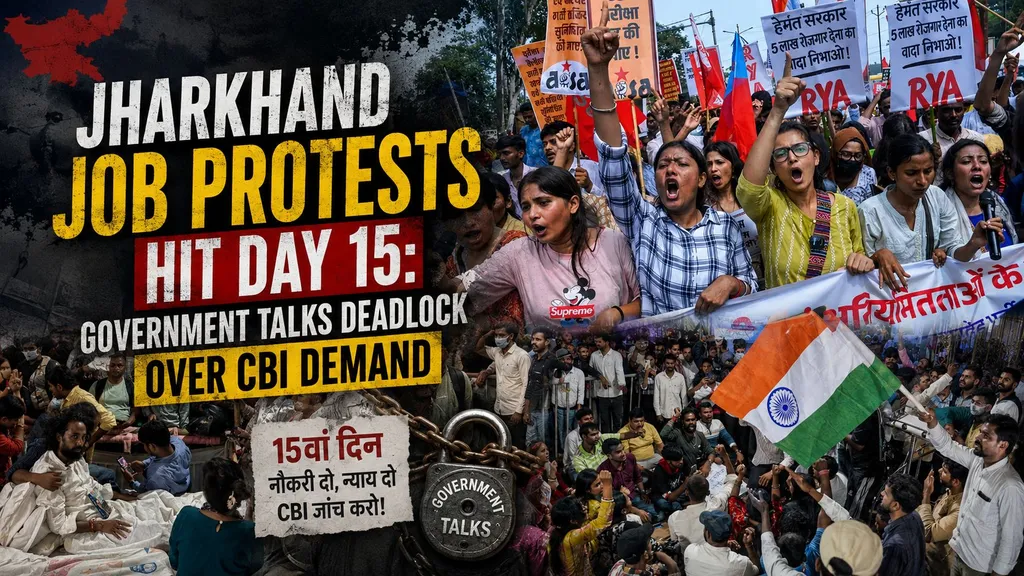
RANCHI — The ongoing agitation over alleged systemic irregularities in Jharkhand’s state recruitment examinations has reached a critical boiling point. Entering its 15th day on Saturday, the massive demonstration anchored at Ranchi's Jaipal Singh Munda Stadium remains unbroken, even after the first round of direct negotiations with the state government failed to produce a concrete resolution.
The movement, which formally commenced on July 25 under the banner of the JPSC-JSSC Reforms Manch, represents one of the largest and most sustained student-led uprisings in the state’s recent history. At the heart of the crisis are allegations of severe manipulation, paper leaks, and lack of transparency regarding the 14th Jharkhand Public Service Commission (JPSC) preliminary examination and the Jharkhand Staff Selection Commission-Combined Graduate Level (JSSC-CGL) exams.
The Deadlocked Dialogue
Following weeks of rising tensions, Chief Minister Hemant Soren signaled a willingness to engage in dialogue with the protesters earlier this week, asserting that his administration was prepared to address their grievances. This culminated in a late-night meeting on Friday between a state government panel headed by Higher and Technical Education Minister Sudivya Kumar and a revised 10-member student delegation.
The path to the negotiating table was not without friction. The students had initially proposed an 11-member delegation that included a legal expert and media representation to act as silent mentors. However, this was swiftly rejected by Minister Kumar, who accused opposition forces and the state's "coaching mafia" of attempting to hijack a genuine student movement. To facilitate the talks, the protesters acquiesced, dropping the non-student members and finalizing a purely student-led panel consisting of Ravindra Paswan, Piyush Kumar, Rajesh Prasad, Neetu Kujur, Ankit Raj, Kartik Soren, Shalu Kumari, Ravindra Kumar Ravi, Anand Kumar, and Ankit Kumar.
Despite the concession and what both sides described as a "positive atmosphere," the talks ended in a stalemate. The government pledged to review the issues, but the student delegation emerged steadfast in their resolve. "The government assured us that our demands would be considered. However, we have decided to continue our protest until all our demands, including the cancellation of the 14th JPSC examination, are fulfilled," a representative for the JPSC-JSSC Reforms Manch stated immediately following the meeting.
A Comprehensive List of Demands
The demonstrators have presented a non-negotiable charter of demands aimed at overhauling the state’s fundamentally flawed hiring architecture. Chief among them is the immediate cancellation of the 14th JPSC prelims and the initiation of an independent inquiry—either by the Central Bureau of Investigation (CBI) or a panel of retired high court judges from outside Jharkhand.
Furthermore, the students are demanding structural transparency: the public disclosure of category-wise cut-offs (UR, EWS, BC-I, BC-II, SC, ST), the release of OMR copies and response sheets, and strict punitive action against examination mafias. To prevent future administrative collapses, they are pushing for a standardized, UPSC-modeled recruitment calendar that legally binds the state to timely examination and result cycles.
The Human Toll of the Hunger Strike
The physical toll of the protracted standoff has become a pressing concern for both civil society and state officials. An indefinite hunger strike, which began in earnest on August 2, continues to threaten the lives of key protest figures. On Friday, student leader Rahul Kranti—one of six individuals fasting—was rushed to Ranchi Sadar Hospital after his condition rapidly deteriorated. Kranti had been refusing food since Tuesday night.
The hospitalization prompted rapid political maneuvering. Acting on instructions from the Chief Minister, Health Minister Irfan Ansari visited the hospital to ensure Kranti was receiving specialized medical supervision. Simultaneously, Leader of the Opposition Babulal Marandi (BJP) visited the ailing student leader, urging the youth not to risk their lives for a battle that requires long-term endurance.
Meanwhile, a parallel faction led by Jharkhand Loktantrik Krantikari Morcha (JLKM) leader Devendra Nath Mahto, who has been on a hunger strike for six days, confirmed they were invited for a separate round of talks at the state guest house on Saturday morning. Speaking to the media before the meeting, Mahto questioned the government's strategy of divided negotiations. "It doesn’t matter how many of us go to meet them. All of us have the same demands, which should be fulfilled," Mahto stated.
Political Echoes and Systemic Failure
The unrest in Ranchi cannot be viewed in isolation; it is the culmination of a deeply entrenched crisis that has plagued Jharkhand since its statehood in 2000. Over the past 24 years, the state's recruitment machinery has been trapped in a relentless cycle of delayed notifications, paper leaks, cancelled exams, and protracted legal battles.
For the thousands of aspirants surviving on meager monthly budgets—often sleeping on railway platforms just to sit for exams that are subsequently annulled—the process of seeking government employment has devolved into an economic and psychological endurance test. The recent controversies surrounding the national NEET-UG leaks have only hardened the resolve of Jharkhand's youth, who view this moment as a tipping point.
The political fallout is now manifesting across the capital. On Saturday, the Akhil Bharatiya Vidyarthi Parishad (ABVP) initiated a march toward the Chief Minister's residence in solidarity with the job aspirants. A day prior, Left-backed student organizations, including the AISA and AISF, organized a similar march toward the State Assembly. Inside the legislature, BJP lawmakers continuously disrupted proceedings, demanding a court-monitored CBI probe into the hiring irregularities and successfully forcing an adjournment of the House.
As the state government scrambles to placate multiple protesting factions and the political opposition weaponizes the crisis, the core issue remains fundamentally unresolved. Until tangible administrative reforms are enacted and the specter of corruption is removed from the examination process, the youth of Jharkhand appear fully prepared to hold the line at Jaipal Singh Munda Stadium.