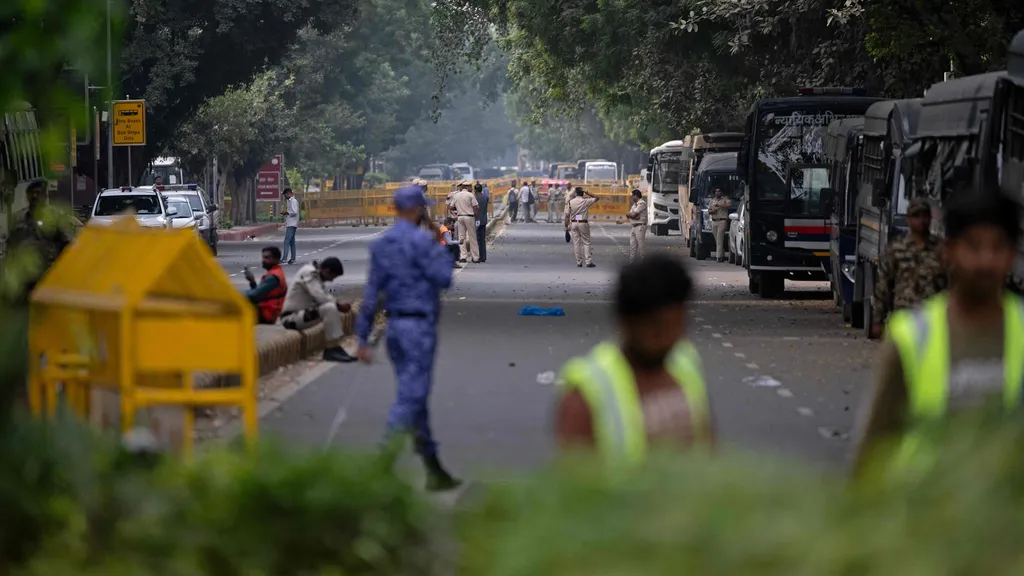
New Delhi, October 12: Delhi Police has de-notified Jantar Mantar as the capital's designated protest venue. This ends a role the site has held for more than three decades. A standing order dated October 11, signed by Police Commissioner Anurag Kumar, names three new sites for protests and demonstrations: Ramlila Ground in Old Delhi, CBD Ground in East Delhi and Burari Ground in North Delhi.
The order partially modifies an earlier one dated April 28, 2022, which had listed Jantar Mantar as a protest venue. Police have said separate standard operating procedures (SOPs) for the new sites will follow.
What has changed
Jantar Mantar: no longer a designated protest site.
Ramlila Ground (Old Delhi): the new venue closest to the old one, reported to be about 3 km away.
CBD Ground (East Delhi): reported to be about 13.5 km away.
Burari Ground (North Delhi): reported to be about 44 km away.
The distances come from a single media report and should be treated as approximate.
Why the decision came now
On October 9, a Supreme Court bench led by Chief Justice of India Surya Kant, with Justices Joymalya Bagchi and V. Mohana, said Delhi should identify a larger, better-equipped space for protests. The court said such a site should have basic facilities such as toilets, drinking water, portable cabins and medical help. It should also be spacious enough for emergency services to reach demonstrators.
The observation came during hearings on pleas against sweeping metro and railway restrictions imposed before the October 10 protests. Senior advocate Kapil Sibal told the court that Ramlila Maidan had earlier served as an alternative venue. He said it was not offered when permission for Jantar Mantar was denied.
The police order was issued on the recommendation of a committee set up by the Union Home Ministry. It does not explicitly link the decision to any single protest.
The backdrop: tight security in the capital
The change comes at a tense moment. Delhi Police refused permission for the Cockroach Janta Party's (CJP) October 10 protest at Jantar Mantar. They imposed prohibitory orders under Section 163 of the Bharatiya Nagarik Suraksha Sanhita in New Delhi district. More than 20,000 police and paramilitary personnel were deployed. Police also asked the metro to consider closing gates at 57 stations. The protests demand accountability from Chief Election Commissioner Gyanesh Kumar over alleged irregularities in the Special Intensive Revision (SIR) of electoral rolls. On October 12, an INDIA bloc march to the Supreme Court on the same issue was also under way.
Opposition groups and protest organisers criticised the move, saying the new venues are far from Parliament and the centres of power, and that this weakens the visibility of protests. CJP leader Abhijeet Dipke said on X that the whole country would now become Jantar Mantar.
A site with a long history
Jantar Mantar became Delhi's main protest ground in 1993, after authorities moved demonstrations away from the Boat Club lawns near India Gate. In 2017, the National Green Tribunal banned protests along Jantar Mantar Road and directed them to Ramlila Maidan, citing noise, sanitation and the occupation of public space. In July 2018, the Supreme Court set aside that blanket ban. It held that peaceful protest cannot be prohibited outright, though it can be regulated to protect residents and public order.
Is this a ban on protests?
No. De-notifying a site is not a blanket ban on peaceful demonstrations in Delhi. It changes where protests are officially designated and permitted. Under the Home Ministry's own account, permission can still be refused for administrative infeasibility, unmet conditions, law-and-order concerns or short-notice applications. Public order and policing are State subjects under the Seventh Schedule.
What to watch next
SOPs: the rules on permissions, crowd limits and facilities at the three sites are yet to be issued.
Access: critics are likely to ask whether Burari, about 44 km away, can work as a practical venue for protesters and the media.
Courts: the move may face legaal scrutiny, given the Supreme Court's 2018 ruling on the right to protest.
Protests: the CJP and opposition groups have signalled they will keep demanding access to Jantar Mantar.