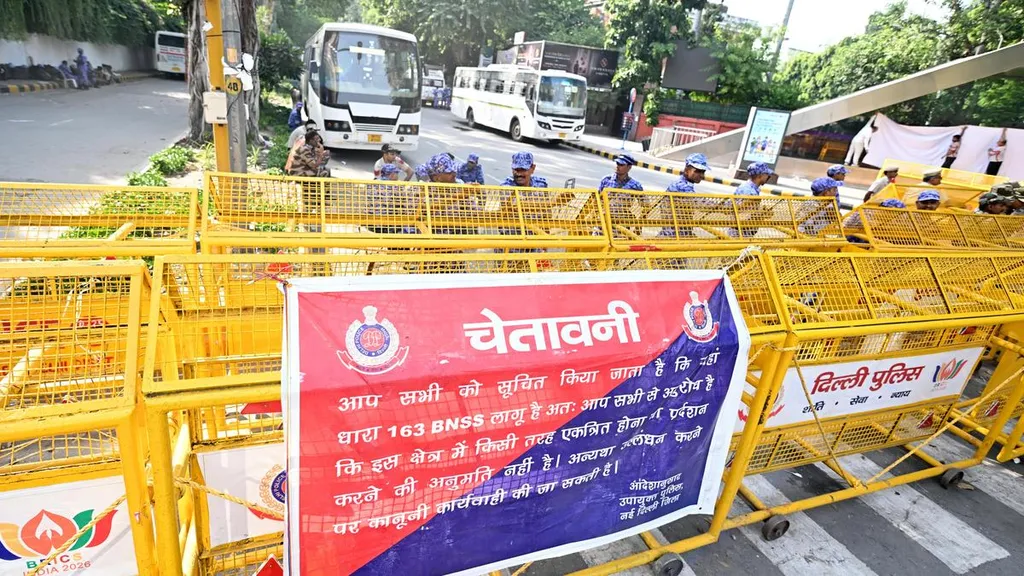
NEW DELHI: Delhi was turned into a fortress today, October 10, as the Cockroach Janta Party (CJP)-led protest demanding the resignation of Chief Election Commissioner (CEC) Gyanesh Kumar went ahead. Authorities detained people, cancelled trains, closed 45 metro stations and suspended mobile internet in central Delhi.
The crackdown began well before the protest. The Delhi Metro Rail Corporation said entry and exit gates at 57 stations would stay closed from 9 pm on October 9 until the situation normalised. The railways cancelled all mail and express trains due at New Delhi and Hazrat Nizamuddin stations between 4 am and 2 pm on Saturday, and around 26,000 Central Armed Police Forces personnel were deployed in Delhi. At least 245 trains beginning and ending at Delhi stations were reported cancelled. Police also visited colleges, mosques and resident welfare associations to discourage people from joining the protest.
The detentions began the night before and continued through the day. Some people were picked up from their homes or on the streets during the night, and others were stopped at their homes before they could leave. The CJP claims at least 10,000 people were detained across India ahead of the Delhi protest. Police said about 500 protesters were detained across the city on Saturday, and about 100 were held in the inner circle of Connaught Place. Those detained include leaders of the movement. CJP founder Abhijeet Dipke was detained with other leaders as their plane landed in New Delhi, according to the party, and the party said influencer Dhruv Rathee was detained at the protest site. The numbers have not been independently verified.
The detentions have also reportedly swept up people who had nothing to do with the protest. According to accounts circulating on social media, which this publication has not independently verified, a man who had come to Delhi to meet a hospitalized relative was detained even though he was not a protester. If confirmed, the case would show how indiscriminate the clampdown was.
The trigger for this round of protests was an investigation by The Indian Express. The September 23 report revealed that Election Commissioners Sukhbir Singh Sandhu and Vivek Joshi had formally objected 14 times in 10 months to poll panel decisions related to the Special Intensive Revision (SIR) of electoral rolls, saying some were taken without their knowledge. The dissenting commissioners reportedly flagged unauthorized changes to voter software and the centralization of the database. Opposition groups allege that the SIR is being used to remove millions of voters from the rolls, particularly minorities and economically weaker sections, to the benefit of the ruling party. Critics say the voter-list revisions benefited Modi's BJP. The Election Commission has largely rejected the allegations of wrongdoing.
This is not the first confrontation. On October 2, Delhi Police detained hundreds of protesters at Jantar Mantar during a scheduled protest seeking Kumar's removal over his unilateral decisions in the SIR exercise.
Kumar's past is also under scrutiny. The Kerala government has reportedly announced that it is reopening a 2006 vigilance probe into the death of Lee See Been, a Malaysian project engineer. See Been's suicide note reportedly named Kumar, then the state's Public Works Department secretary, alleging harassment over delayed payments for a World Bank-funded road project.
The debate has also revived questions about how Kumar was appointed. Rahul Gandhi submitted a dissent note during the selection process, but the government went ahead and made Kumar the 26th Chief Election Commissioner. He was chosen under a 2023 law that gives the ruling government a majority in the selection committee. Removing a CEC is also very difficult. It requires a parliamentary impeachment process on the same constitutional grounds as for a Supreme Court judge. Opposition leaders have said they will take their grievances to President Droupadi Murmu.
Editorial note
A security response on this scale reveals more than it conceals. When a democratic government answers a public demonstration with cancelled trains, shuttered metro stations, a mobile internet shutdown and thousands of preemptive detentions, including at night and at people's homes, it shows institutional anxiety, not authority. If the electoral rolls are clean, the Commission's decisions are defensible and its procedures can withstand scrutiny, there is nothing to fear from citizens carrying placards. The question the public is left asking is hard to avoid: if everything is above board, why is the administration so desperate to shield its Chief Election Commissioner from public inquiry?