
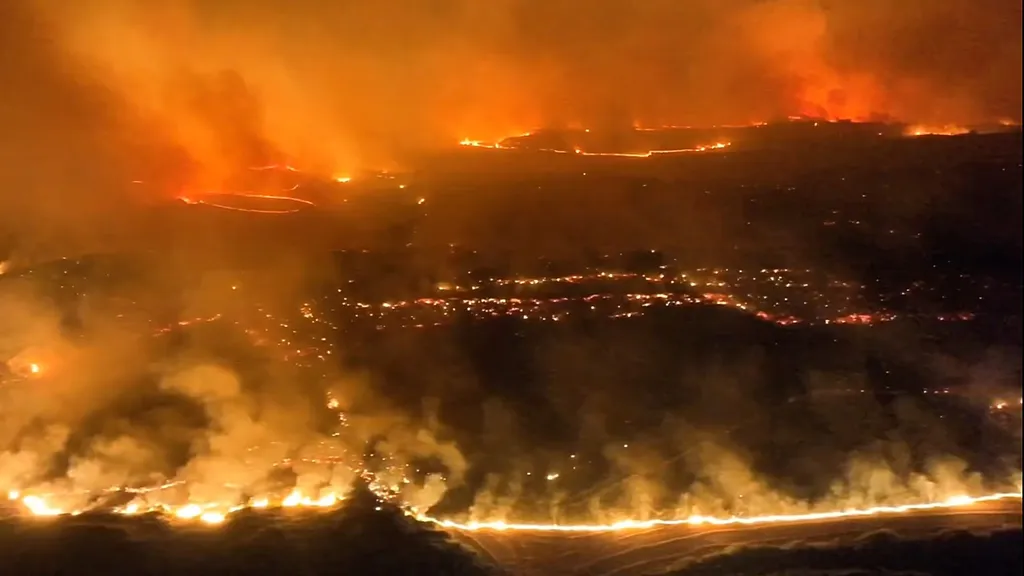
Wildfires have scorched large swaths of the Spanish countryside over the past week, prompting evacuations that now exceed 70,000 people across several autonomous communities.
Three separate blazes in the Madrid region have drawn particular attention as a new heatwave, forecast to begin on Wednesday, threatens to intensify the fires. The national meteorological agency Aemet warned that fire‑danger levels will climb to “extreme” levels, complicating suppression efforts.
Temperatures are expected to approach 40 °C in parts of the country, with the heatwave projected to last at least until Sunday. The Madrid region is currently under a red weather warning, with forecasts of 35 °C in mountainous zones and up to 38 °C elsewhere.
It’s a hell of a situation.
Madrid regional president Isabel Díaz Ayuso said this while touring the affected areas on Monday alongside Prime Minister Pedro Sánchez.
Ayuso confirmed that four municipalities remain under lockdown orders and that an additional 12 towns have been evacuated. Earlier, she described the wildfires as “the biggest natural catastrophe in the history of Spain,” adding that flames have turned the area into a “war zone.”
Since the fires broke out, more than 56,500 residents of the Madrid region have been evacuated, while 27,797 people have been instructed to stay at home. Evacuations have also taken place in the provinces of Ávila, Toledo and Valencia.
We are facing highly challenging hours and days ahead, but there is light beginning to appear at the end of the tunnel.
Prime Minister Sánchez told reporters on Tuesday, emphasizing the need for continued effort.
On the same day, Sánchez declared the fire‑stricken zones “disaster areas” and urged unified action against the climate emergency, stating: “Climate denial is the worst fuel for the fight against the climate emergency.”
Interior Minister Fernando Grande‑Marlaska, speaking on Spain’s La 1 television channel, said Monday night’s firefighting operations yielded “relatively positive progress.” He added, “This morning we are very satisfied with the work done. We are going to consolidate the work that has been done… we must be positive; we have the emergency under control,” while acknowledging that adverse weather conditions are hampering the response.
Spanish journalist Juan Navarro, reporting from Cebreros—about 40 miles west of Madrid—described the scene as one where “everything is black,” noting that residents watched the advancing flames with palpable fear.
Mayors of two evacuated towns in the Madrid region characterized the fire’s behavior as “a kitten by night and a lion by day.” Robledo de Chavela’s mayor Fernando Casado pledged that his community would keep fighting “with their knives out,” while Valdemaqueda’s mayor Ricardo Meneses warned, “We can’t let our guard down and we’re on high alert because now is the time to stop the fire.”
Ayuso posted on X that the situation is “improving little by little,” suggesting that some displaced residents may soon be permitted to return to their homes.
The national government’s delegation in Madrid reported that the fire “remains active and uncontrolled,” and said today’s priorities are “surveillance and cooling the affected areas in anticipation of the forecast worsening of weather conditions.”
Ecological Transition Minister Sara Aagesen estimated that roughly 77,000 hectares (190,000 acres) have burned nationwide. She identified the blaze in Ávila as the largest in recent Spanish history, noting that more than 50,000 hectares have been consumed there since the outbreak. While the fire’s evolution was described as “quite favourable” overnight, emergency services continue to monitor “small flare‑ups,” according to Nicanor Sen.
In Valencia, authorities lifted a lockdown for the town of Vall D’Uixo after a fire ignited on 25 July, which had forced about 16,000 people from 20 municipalities to evacuate.
Across the border, Portuguese firefighters are battling a large fire on three active fronts in the eastern Guarda area.