India and the United States continue to deepen strategic cooperation even as Washington moves toward giving the president significant new tariff authority against major purchasers of Russian energy. For New Delhi, the contradiction is becoming harder to manage.
In This Article
Two events, one relationship
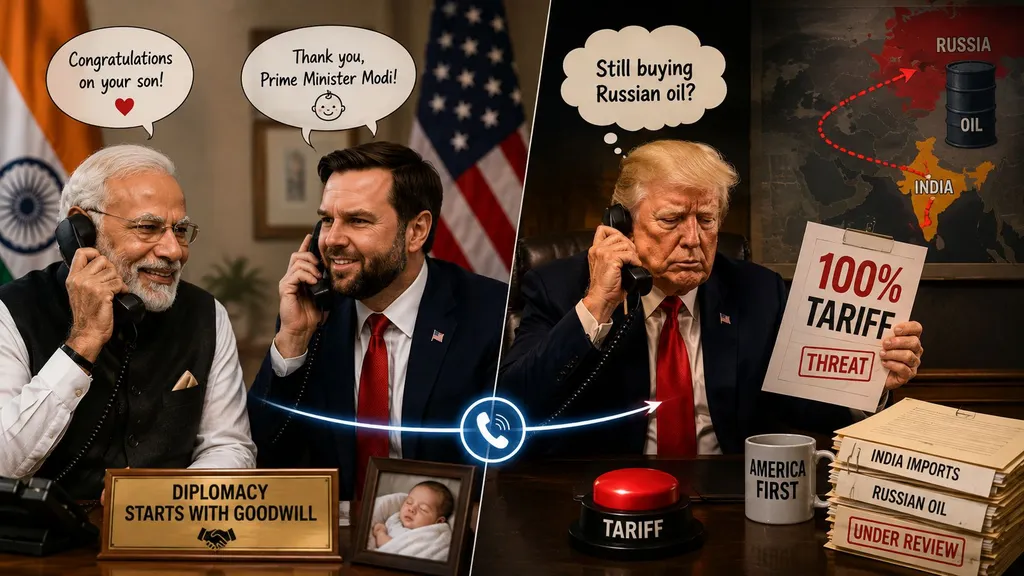
On August 8, Prime Minister Narendra Modi and U.S. Vice President J.D. Vance spoke by telephone. India’s official readout said they discussed ways to deepen the India-U.S. Comprehensive Global Strategic Partnership, including trade and defence, critical and emerging technologies, energy security and critical minerals. Modi also congratulated Vance and Second Lady Usha Vance on the birth of their son.
One day earlier, the U.S. Senate had overwhelmingly passed the Lindsey O. Graham Sanctioning Russia and Iran Act of 2026 by 86–11. The legislation includes authority for the president to impose targeted tariffs of up to 100% on imports from qualifying major purchasers of Russian oil or gas.
The Senate vote: a threat, not yet a tariff
The legislation is the culmination of a sanctions effort Senator Lindsey Graham and Democratic Senator Richard Blumenthal had pursued since 2025. The revised measure narrowed the tariff threat from an earlier proposal that contemplated tariffs as high as 500%. The revised framework caps the potential tariff at 100% for the top five purchasers of Russian crude or gas, while also targeting Russian officials, financial institutions, the shadow fleet and other parts of Moscow’s sanctions-evasion network.
The Senate’s August 7 vote was 86 in favour and 11 opposed. The bill now faces the House. The House path is less certain because lawmakers have raised concerns about granting President Donald Trump broad tariff discretion and about the effect of high tariffs on U.S. consumers and importers.
The legislation also contains waiver and exemption mechanisms. The existence of a 100% ceiling should therefore never be presented as proof that India will face a 100% tariff.
India is directly exposed to the Russian-crude provision
According to Senate aides cited by Reuters, the five largest purchasers of Russian crude were China, India, Slovakia, Hungary and Azerbaijan. The separate list for Russian natural gas is different: China, France, Japan, Hungary and Belgium.
India’s Russian-oil pivot has become enormous
Reuters, citing preliminary Kpler and LSEG ship-tracking data, reported that Indian refiners received about 2.70 million barrels per day of Russian crude in June 2026. Kpler put India’s May Russian-crude intake at 2.13 million barrels per day, equal to 36.5% of total crude imports. In June, Russian crude accounted for more than half of India’s roughly 4.9 million barrels per day of total crude imports.
That June increase came as Indian refiners sought Russian barrels amid disruptions affecting other supply routes, including the Strait of Hormuz.
Business Standard, citing Kpler, reported Russian crude receipts of about 2.8 million barrels per day in the week beginning June 29 and 2.7 million barrels per day in the week beginning July 6. Those are weekly observations and must not be relabelled as monthly averages.
Why the oil matters beyond the refinery gate
The Ministry of Petroleum and Natural Gas says India has 258.1 million tonnes per annum of installed refining capacity across 22 operational refineries. Domestic petroleum-product consumption reached 243.2 million tonnes in FY2025-26, while petroleum-product exports were 61.5 million tonnes.
India is therefore a major refining and refined-product exporting power. But it is not technically locked into Russian crude. Indian refiners process a diversified crude basket, and purchases from the Middle East, the Americas, Africa and Russia can change with price, availability and freight.
The strategic issue is the cost of replacement. Russian barrels became commercially attractive because discounts and supply availability improved the economics for Indian refiners during a period of global disruption.
Where the tariff pressure actually lands
This distinction is essential. The bill does not simply tax Russian barrels arriving at Indian ports. Its pressure mechanism works through trade: goods from qualifying Russian-energy buyers could face higher U.S. import costs if the president uses the authority.
That creates a conflict between two parts of India’s strategy. Cheap Russian crude can support refinery economics, while the U.S. market remains one of India’s most important export destinations. If U.S. tariffs became extremely high, exporters could absorb costs, redirect shipments, seek exemptions or reassess the economics of their crude sourcing.
India’s exposure to the U.S. market is broad
Government economic-diplomacy data put India’s FY2024-25 goods exports to the United States at about $86.5 billion. Petroleum products are only one part of that relationship. A broad tariff shock could reach manufacturing, engineering goods, pharmaceuticals, textiles, electronics and other sectors depending on the final tariff scope.
The Graham bill should therefore be understood as an indirect economic-pressure mechanism aimed at changing the behaviour of major Russian-energy buyers, not simply as an oil tariff.
The tariff history is more complicated than a straight line
In August 2025, the White House imposed an additional 25% tariff on Indian imports because India was importing Russian oil. In February 2026, the White House removed that additional 25% tariff. The U.S.–India joint statement said the United States would apply an 18% reciprocal tariff rate under the new trade framework.
The new Senate bill is a different mechanism. It would potentially give the president a statutory route to impose much higher tariffs on qualifying major Russian-energy buyers. The accurate policy sequence is therefore: pressure → negotiation → removal of the Russia-oil tariff → new sanctions legislation.
India is not locked into Russian crude
Indian refiners can diversify. The country has repeatedly adjusted its crude basket when geopolitical and logistical conditions change. The June surge itself illustrates this flexibility: Russian purchases rose when other supplies were disrupted.
The trade-off is cost. Replacing discounted Russian crude with more expensive or less conveniently routed barrels could increase the energy bill. That does not make diversification impossible; it makes it a price-and-security decision.
The diplomatic channel remains open
The August 8 Modi–Vance conversation shows that Washington and New Delhi are not treating the relationship as broken. The official Indian readout emphasised cooperation in trade, defence, technology, energy security and critical minerals.
Strategic partnerships do not eliminate disputes over energy, tariffs or sanctions. They can make those disputes more consequential because each side has more economic and geopolitical leverage over the other.
What happens next
House consideration — The Senate-passed bill still has to move through the House, where the breadth of the tariff authority is already a point of concern.
Final legislative text — The measure could be amended. Thresholds, exemptions and waiver provisions will matter.
Presidential decision — Even if enacted, 100% is a ceiling, not an automatic rate.
India’s response — New Delhi can negotiate, diversify crude sourcing, redirect exports, seek exemptions or combine several strategies.
The real strategic paradox
The simplest version of this story is that Washington is threatening India over Russian oil. The fuller reality is more complicated.
India and the United States remain strategic partners. They are cooperating on defence, technology, trade, energy and critical minerals. At the same time, Washington is attempting to reduce the revenues Russia receives from energy exports, and India is one of the world’s largest buyers of Russian crude.
Those realities do not cancel each other out. They exist simultaneously.
The diplomatic relationship remains active. The economic pressure is rising. India’s Russian-oil strategy has become too large to remain a peripheral issue in the India-U.S. relationship.
Sources
Primary sources
India Ministry of External Affairs — official readout of the August 8, 2026 Modi–Vance call. India Ministry of External Affairs — Modi–Vance call
U.S. Senate — Senate passage and vote information for the Graham sanctions legislation. U.S. Senate — Russia sanctions legislation
Ministry of Petroleum & Natural Gas / PIB — India's refining capacity, FY2025-26 domestic petroleum consumption, and petroleum-product exports. Government of India — Petroleum Refining and Exports Data
Ministry of Commerce & Industry / DGCIS — official merchandise export statistics and full-year trade data. DGCIS — Merchandise EXIM Trade Data (Full Year)
Reporting and market data
Reuters — August 7 Senate vote, legislative status and House uncertainty. Reuters — U.S. Senate passes Russia sanctions bill
Reuters / Kpler / LSEG — May and June 2026 Indian Russian-crude import data. (MarketScreener India)
Business Standard / Kpler — late-June and early-July Russian crude receipts. Business Standard — Russian crude discounts and Indian imports
Indian Express — identification of the five largest Russian-crude purchasers under the revised bill. Indian Express — revised Russia sanctions bill