
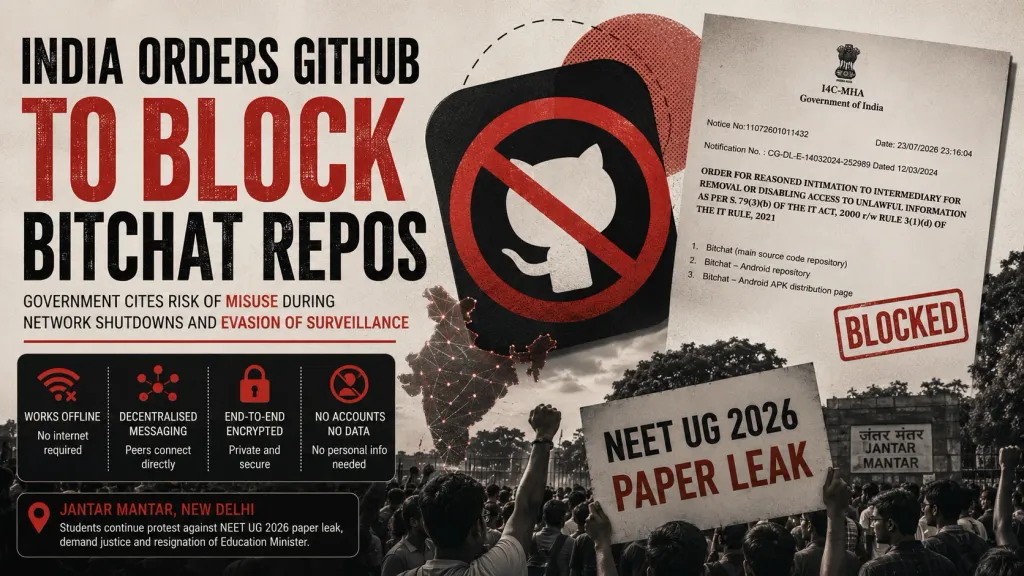
The Indian government has instructed GitHub to block three repositories that host the source code of Bitchat, an offline messaging app created by Twitter co‑founder Jack Dorsey. The directive, issued by the Indian Cyber Crime Coordination Centre (I4C) on July 23, was shared publicly by Dorsey, who also posted a copy of the order.
According to the I4C notice, the application could be exploited to bypass lawful surveillance and to coordinate unlawful assemblies when internet services are restricted. Citing intelligence inputs, the centre warned that platforms like Bitchat might be used by anti‑national elements, terrorist organisations, organised crime groups and cybercriminals to evade detection.
“The application’s design, which enables communication even during network restrictions, creates a substantial risk of misuse by anti‑national elements, terrorist organisations, organised criminal groups, and cybercriminals seeking to evade lawful detection and continue communication despite legally imposed restrictions,”
The order invoked Section 79(3)(b) of the Information Technology Act, 2000, together with Rule 3(1)(d) of the Information Technology Rules, 2021, and gave GitHub a three‑hour window to disable access to the main source‑code repository, the Android repository and the page used to distribute the Android installation file.
Bitchat is an open‑source, decentralised messaging tool that lets nearby users communicate without mobile data, Wi‑Fi, phone numbers or central servers. It relies on Bluetooth Low Energy to create a peer‑to‑peer network, allowing each device to relay messages through up to seven “hops.” When an internet connection is available, the app can also route messages via the decentralised Nostr protocol. All private chats are end‑to‑end encrypted, and the platform does not require users to create accounts or provide persistent identifiers.
The I4C described Bitchat’s architecture as “significantly impeding lawful interception, attribution, and investigation by law‑enforcement agencies.” It argued that the app’s ability to function during network shutdowns poses a “substantial risk of misuse” by groups seeking to continue communication despite legally imposed restrictions.
Jack Dorsey responded to the order, stating, “The government of India does not like technologies like Bitchat and wants it taken down.” He also noted that queries sent to the Union Home Ministry had not been answered at the time of publication.
The blocking order coincides with a series of internet shutdowns in central Delhi linked to student protests at Jantar Mantar. On Thursday, authorities ordered mobile data services to be suspended within a 1.5‑km radius of the protest site and around the Mandi House area, roughly two kilometres away. This marked the sixth such suspension in a week, disrupting not only demonstrators but also nearby offices, shops and commuters, many of whom reported an inability to process UPI payments or access messaging and app‑based services.